Celia’s two selves
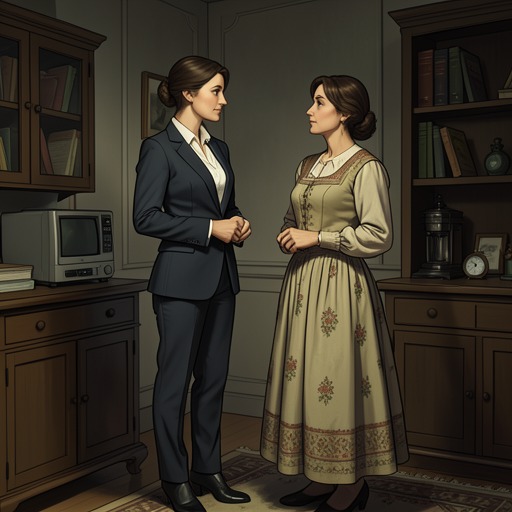
All the Old KnivesCelia’s two selves is the book’s name for the tension between Celia Favreau’s former identity as an intelligence professional and the family-centered life she establishes after leaving the Agency. It is at once Celia’s account of a genuine change in priorities and Henry Pelham’s troubling question about whether any version of her can be separated from the skill with which she constructed identities. The distinction remains unresolved: the new Celia may be the self that had always existed beneath a professional shell, or another persuasive story shaped by the woman who once excelled at manipulation.
The Two Selves and Their Origins
The division begins with Celia’s move from Vienna to California with Drew Favreau and their children. In the narrator’s account, the new life is not merely a change of address. Celia gradually withdraws from the people and habits associated with her former existence, as if making room for an identity less burdened by the past. For six months after the move, she maintains a Facebook page featuring the beach, quaint restaurants, and upscale parties. The images feed Viennese jealousy and attract discussion at the embassy; then she abruptly closes the page. Old friends receive slow email replies, often apologizing for how busy she has been. The outward display of the new life gives way to a quieter, more thorough separation from the old one.
Celia’s busyness has substance. She becomes staff photographer for the Carmel Pine Cone, volunteers at the Sunset Center, where traveling musicians perform midcentury hits for retirees, and takes a part-time job at the Stevenson School by the time she is pregnant for the second time. She also meets her therapist, Dr. Leon Sachs, for two hours each week. The narrator cannot access Sachs’s notes, so the work of therapy remains unseen. What can be observed is Celia’s effort to build a future for herself or her child, while the narrator interprets her slow replies and abandoned online presence as signs that she has decided to be done with her former existence. In that reading, Celia 2 is not simply occupied; she is deliberately cutting away what might threaten the life she intends to lead.
Celia’s Account of the Change
When Celia explains her move, she presents family not as a convenient explanation but as the destination she had long postponed. Her parents, she says, taught her to be like them; without the security of family around her, she felt only half a person. She describes her years with the Agency as an addiction: the thrill of secret knowledge kept her focused on the next high rather than on what might make her whole. Her account reframes the move with Drew as a belated choice of the life she had wanted, not an escape into a future invented after the fact.
The contrast is sharpened by the force and confidence of her speech. Celia speaks fluently and without reservation, displaying the same command of conversation that had once enabled her to spin a story, improvise, and draw a listener into a maze of fabrications convincing enough to remain uncertain years later. The very ease with which she explains her choice therefore supports two readings. Her candor may reveal a self that her professional role had obscured; but her proven ability to make invention feel authentic gives Henry reason to wonder whether candor, too, can be performed.
Henry Pelham’s Uncertainty
Henry’s dilemma is not solved by deciding that one Celia is real and the other false. He considers whether Celia 2 was always present behind the constructed shell of Celia 1, and whether their present encounter finally brings him face to face with the person he had been missing. Yet even that hopeful interpretation leaves open what he loved. He wonders whether he loved Celia 1, a person who never existed; whether he sensed the other self beneath her professional identity; or whether the identity he cherished was partly a reflection of his own desires.
This uncertainty belongs to Henry’s limited perspective, not to a definitive account of Celia’s inner life. He recognizes that his questions arise from confusion, and he does not disclose them to her. He is listening to a self-assured woman whose words bring back the possibility of love, while also confronting the professional purpose of their meeting: his phone is recording their conversation, and Treble remains part of the job. The scene thus places personal attachment and intelligence work in the same room without allowing either to settle the question of who Celia is.
Identity as an Unfinished Story
Celia’s two selves are not presented as a clean conversion from falsehood to truth. Her own explanation joins the identities rather than simply erasing one: the Agency years were real, the family longing was real, and the former may have distracted her from the latter. Meanwhile, the narrator’s account of her new routines makes the change visible through particular acts of withdrawal, work, and preparation for family life, but cannot establish whether these acts reveal an underlying self or create a new one.
That unresolved distinction gives the concept its importance. Celia’s professional talent for constructing stories makes every declaration of authenticity harder for Henry to accept, while his lasting attachment makes his judgment vulnerable to the idealized person he wants to recognize. The book leaves both pressures active. Celia may have found a life closer to her own sense of wholeness, yet neither her fluency nor Henry’s love can prove that the self beneath the stories was ever singular or fully knowable.